Hi, this is Kenaniah Santhosh Raj, the author of this blog. I'm an engineer, writer, and a self-help enthusiast. If you would like to read my poems and short stories, follow me on Instagram @words_by_ken.
The title of this post is an age-old saying — perhaps the most widely used piece of advice in the world’s history. How does this advice stand the test of time? One reason is that people rarely follow it or even try to follow it. Due to life’s overwhelming nature, we often forget the biggest necessity that life demands — the pursuit of one’s dreams.
In this post, I would like to discuss Santiago, the protagonist of Paulo Coelho’s international bestseller, The Alchemist. This story is about a young boy who chases a recurring dream with all his heart and soul and, in the end, has a surprising revelation about his dream.
Short Summary
Santiago is a young shepherd from the Spanish province of Andalusia. Growing up with the ambition of travelling the world, Santiago pursued being a shepherd to move around tending his sheep.
Troubled by an unfinished dream about a hidden treasure near the Egyptian pyramids, he wanted to sell his sheep and travel the world to explore the meaning of his dream. In the early days of his dream, he seeks the help of a Gypsy woman for the interpretation, but he doesn’t get the answer he was looking for.
But soon, he unexpectedly meets a wise old man, who happens to be Melchizedek, the king of Salem. Following the king’s advice, the little boy journeys toward the Egyptian pyramids.
This journey to Egypt was no easy one. It would turn his life upside down and push him to his limits. He gets off to a disastrous start when he gets robbed by a fellow in Tangier and is left with no money to continue. To make ends meet and save money to continue on his journey, he starts a job as a salesman in a crystal shop.
After saving enough money, he boards a caravan to travel through the deserts of Egypt, where he is accompanied by an Englishman in search of an alchemist. At a certain point in their journey, they stop and cool off in an oasis. Hoping that the alchemist would reside here, the Englishmen and the boy go in search of him.
In this pursuit, Santiago meets a beautiful girl named Fatima and falls in love instantly. He conveys his love for her and proposes marriage. They develop a great relationship in the oasis, and their life as a couple blossoms into a meaningful one until Santiago has to resume his journey to the pyramids.
Amidst the never-ending journey of the wilderness, the boy had learned to read omens and to listen to his heart more clearly. In one such instance, his ability to read an omen saves the oasis from an enemy attack. It was during this time that he met with the alchemist.
They converse about the boy’s journey from the pastures of Andalusia to Egypt, and the Alchemist decides to come along with him on his journey. The lion’s share of their conversation was about listening to your heart and staying true to its path.
Three hours away from the pyramids, the Alchemist bids goodbye to the boy and sends him on his way with some gold for him to use. This was the first time that Santiago had witnessed the power of alchemy, as he stood next to the alchemist turning lead into gold.
Though the boy parted ways with him, the alchemist’s words were now etched in his heart forever. As he journeyed closer and closer to the treasure, his words kept echoing inside of him.
When he finally arrived at the location of the treasure, the boy started digging into the dunes. A big twist in the tale awaits. He is caught off guard by the sound of a few footsteps approaching. They were refugees from the tribal wars, and they started enquiring about the boy’s actions.
The boy reveals his mysterious secret, and is met with a spine-chilling response. One of the men looks at him and says that he once had a recurrent dream too, from the same location they were at. He dreamed that he should travel to the fields of Spain and look for a ruined church where shepherds and their sheep slept. He thought that he might find a treasure there under the roots of a sycamore tree. He said he was too stupid to cross a desert because of a dream.
The sycamore tree in that ruined church was the exact place where the boy had had the dream. Soon, he travels back to Spain to visit that church and starts digging for his treasure. He finds a chest of Spanish gold coins and precious stones, and statues embedded with jewels. They were the forgotten spoils of a past conquest.
Even after realising the biggest dream of his life, his heart still yearned for a greater treasure, as the wind brought the scent of Fatima’s perfume.
Lessons from the book
Be ten toes down with your dream. Chase it with all you’ve got
If there’s one thing to take away from this book, it would be this. A lowly shepherd from Spain threw everything away and decided to take on the most gruesome journey of his life with little to no prior knowledge of it, all for the sake of his dream.
I loved how the boy faced adversaries on his journey. There were certain points in his journey, when he was up against mighty men whom he assumed were to attack him, he had a strange sense of joy, knowing that he could die in pursuit of his destiny. He considered such death to be a privilege. What a strange yet powerful view on destiny!
2. When a person desires something, all the universe conspires to help that person realise their dream.
This phrase is repeated many times in the book. What I understand is that the world favours the man who tries the most. I think of it as simple math: The more you try, the more likely you are to succeed.
Santiago’s desire to fulfil his destiny was no joke. He sold all his sheep to gather the money, got robbed twice on his journey, had his journey halted in a strange land and had to hustle to regain his path, got into the middle of the desert during the time of war, left the love of his life back to continue his journey, and met with the biggest surprise at the end of it all.
The fascinating part of all this is that he kept going. None of the hardships could put a full stop to his journey. The difference between the man who has the universe on his side and the man who doesn’t is the difference between Santiago and the refugee. Both had the same dream, but only one was ready to achieve it.
It’s probably the most influential book I’ve ever read. It empowered my dreamer spirit and validated my suffering. If Santiago could suffer, survive and claim his treasure, then so could I. – Will Smith on his memoir
As the title of this post says, this book stands as a reminder to chase our dreams. Paulo Coelho has beautifully articulated the journey of chasing your dream with a sense of delusion, which he compares with the art of alchemy — the magical ability to change lead to gold, leading us to believe that life in itself is a type of alchemy, meaning you can be anything you put your mind to be, and fulfil any dream. This book has planted a great amount of self-belief in me, and I hope it will do the same to you.
Hope you liked reading this post. If you are already a fan of this book, do let me know in the comments how this book helped you. Also, you can share your thoughts on your journey chasing your dreams.
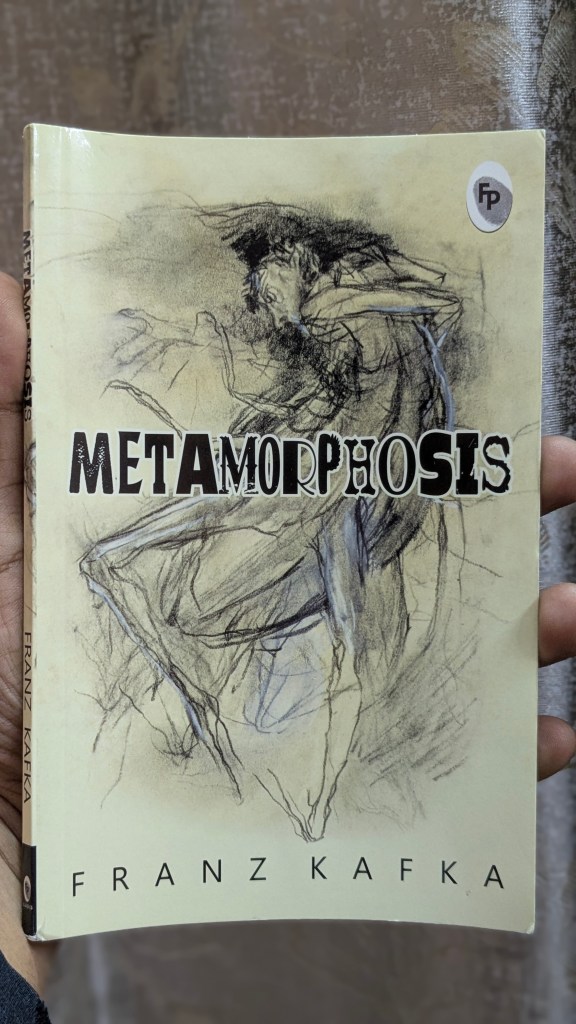
I had encountered the term ‘Kafkaesque’ a few times on the internet. Curious to find out what it was about, I did some research on the works of Franz Kafka and decided to buy his famous novel, ‘Metamorphosis’. Being a non-fiction enthusiast, I’m always a bit sceptical before picking up a fiction book, though I don’t even read them that often, and this time it wasn’t any different. The internet describes the term ‘Kafkaesque’ as extremely unpleasant, frightening, and confusing. Would this style of writing suit someone who isn’t used to the world of fiction? I guess that’s where the creative prowess of an author lies. In this post, I would like to talk about my experience reading this novel and understand the perspective of other readers, too.
Short Summary
The story revolves around the life of Gregor Samsa, a travelling salesman whose life is turned upside down when he is diagnosed with a disorder that turns him into an insect-like creature. This change causes him a lot of physical and mental distress and leaves his whole family in turmoil.
On the day of his disastrous change, he was scheduled to travel for a sales pitch but had dozed off for a long time. Knowing his absence at the workplace, his chief clerk pays a visit to his house and all his problems begin to unravel.
Not willing to reveal his misery yet, Gregor refuses to leave his room for a long time, but after continuous requests from his family and a long rant from his chief, he decides to unlock the door. This moment turns out to be the turning point in Gregor’s new life, as he has his entire family shaken.
Gregor is now focused on convincing his chief that there is nothing abnormal about him and that he can still finish his duty, but is soon chased off and locked into his room by his father. From this point on, Gregor’s life is bound between the walls of his room and hidden in the darkness underneath the furniture.
Far from his normal life, Gregor can no longer be independent, and no longer have freedom or happiness. His parents were now older, and his condition made it all the more difficult for them to comprehend, and it was always his sister who would help him with some of his day-to-day activities.
With every passing day, Gregor’s situation seemed to get worse. His family members could no longer depend on him financially and now had to go to work themselves, and soon his sister’s tight schedule made Gregor feel neglected and alone.
The family took in three lodgers to generate some additional income. One day, as his sister Grete is playing the violin for the lodgers, Gregor shows up in front of them to admire Grete’s performance. The lodgers were shocked by his appearance and decided to leave the house instantly.
Fuming angrily, Grete lashes out at Gregor, and the situation turns ugly. He creeps back to his room in sadness. Sadly, the next morning, the chairwoman of the house finds Gregor lying dead in his room and informs the family. Surprisingly, there wasn’t any grief, just a sigh of relief. After Gregor’s death, the family moves to a new apartment, and they start looking for a husband for Grete.
My Thoughts
I feel that this book is a metaphorical representation of alienation and isolation that occur due to the overwhelming burdens of life, something that is often overlooked, especially with today’s all-hustle, no-rest work culture.
Although Gregor’s metamorphosis seems practically impossible, some of his day-to-day struggles felt relatable. That’s where a lot of credit is due for the writer. Making the audience feel emotions through a humanly impossible story and holding their curiosity to a point where they can’t wait to find out how the character deals with his life is no easy task.
Gregor Samsa’s life is a roller coaster. On one hand, the life-changing disease couldn’t stop him from the worries of financial burdens and family responsibility, on the other, there are times when he doesn’t want to leave his room for a second, hiding behind the darkness had become his routine.
Although it might feel like the metamorphosis is the reason for his alienation, it’s just a revelation to himself on how his life had been. Round-the-clock work schedules had taken hold of his life and had kept him isolated from real human connections, but the disease had put his misery under a microscope.
I can only imagine how often I’ve committed myself to a task, but the leftovers from my day job kept hanging on to a piece of my mind. I can truly relate to being stuck in my routines and always being too busy to indulge in meaningful conversations with the ones around, and also being in a state sometimes where I hated to leave my room, only because I had been accustomed to the isolation.
I can imagine all the times I’ve been sick or on a weekend trip and still have a to-do list lingering in my mind. I feel Franz Kafka might have gone through something similar. I wonder how much he related to Gregor himself.
Interesting perspectives. All arising from a man who turned into vermin!
Overall, I enjoyed reading this work of Kafka, and I’m highly intrigued to explore some of his other works. If you’ve never read this book before, I would recommend you to give it a shot.
Having said all this, I want to interact with some of my readers through this post. I want to know your perspectives on this book and what it meant to you. Share your thoughts in the comments section below. Thank you for reading.
Being the typical over-thinker that I am, I caught myself in a spiral of thoughts last night, and I ended up thinking about the effects of good and bad teachers on our lives.
I was reminiscing on some of the best teachers that I’ve had and some of the great pieces of advice that I’ve heard from them. I heard these back when I was in school, and surprisingly, I still remember and follow them to this day.
I wanted to share these thoughts with you hoping that it will help you in some way or another. Let’s get right into it.
Try your best not to make excuses in life. Look into the bright side of every problem and keep working.
Back in 2016, there was one day in school were I was feeling a little under the weather, and I remember using my sickness as an excuse for not completing my homework.
I still remember this very vividly, because I came back home that day and thought about it a lot. I remember how angry it made my French teacher.
She immediately asked me, “Are you going to make such a silly excuse? Do you know how many people with major health issues and disabilities achieve great things in life?”
Hard questions. But she was 100% right. And my 17-year-old self had no answer for her.
Unfortunately, I didn’t take her advice seriously at the time. But now, years later, I understand the value of that statement. Every time I try to come up with an excuse to procrastinate, I remember my French teachers’ words, “Are you going to make such a silly excuse?”.
Excuses make us feel like victims. A typical excuse may sound different from this, but essentially what it means is — ‘I am a victim of this, so I’m not able to do this’.
That sounds like a weak statement when you word it like this. But it helps you see the true side of it.
I recently started watching a Netflix documentary called ‘The Playbook — A Coach’s Rules for Life’. In the first episode, Doc Rivers, a famous basketball coach, talks about how he helped his team with a certain impediment.
He kept repeating ‘We will not be a victim’ to make his team forget the issue and focus on the game.
I was reminded of my French teacher’s advice when I saw this, almost a decade after first hearing it! I strongly believe that this will be etched in me forever.
2. You have a lot of talent in you, but you are not as good as some of the others just because you’re getting outworked.
It still pisses me off to this day that I didn’t take this advice seriously. It was during one of my English classes(can’t remember if it was in 2016 or 2017), as my teacher was grading an answer sheet, she said this to me.
And again, my young and careless mind didn’t understand why she said that, but now it makes sense. Through experience, I’ve learned that talent without hard work is not of much use, especially if you’re trying to achieve great things.
All my life, I’ve heard people around me say I have great potential to do great things. I feel like I’ve let all that talk water down my need to work. I had never spent any time understanding the importance of deliberate effort.
With time, and a growing interest in self-development, I’m constantly learning the value of deliberate and consistent effort.
I remember a Mike Tyson interview when he was in his prime, the interviewer asked him something about his great talent, and he immediately said “Talent? I don’t believe in talent. You need a lot of willpower and determination to get here”.
Every time I watch a motivational speech on the internet that talks on this topic, I remember the words of my English teacher that I heard many years ago. It is something that will serve as a constant reminder in my life.
I hope that these words will be of great value as you read this. Use this as a constant reminder to keep yourself motivated. If you have similar experiences hearing great pieces of advice, do share them in the comments. Thanks.
Jermaine Cole, one of my favourite rappers ever, said this line in a song that I heard recently –
One thing about this money –
it’s easy to get
but trust me, my brother, it’s hard to keep
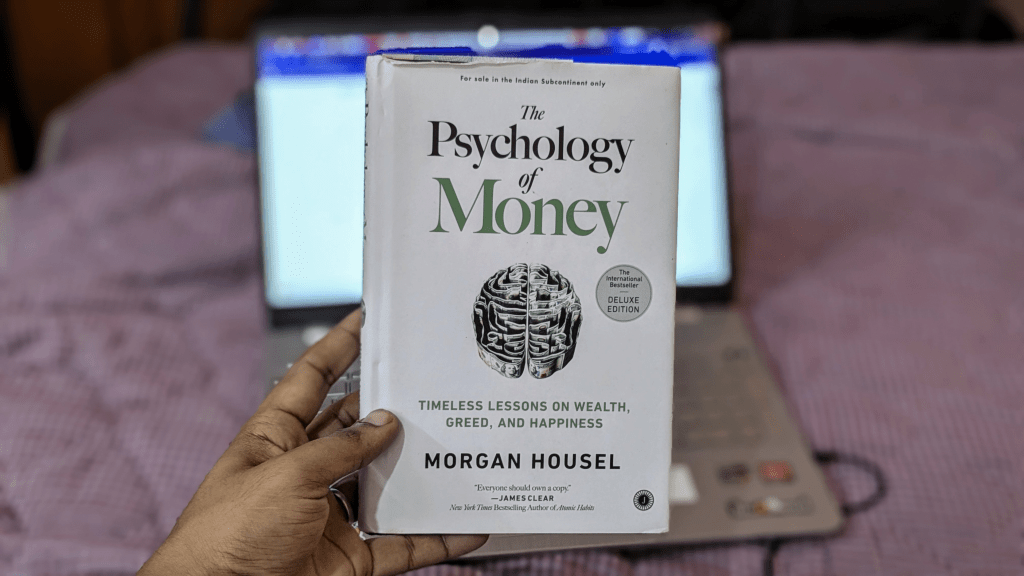
This line hit me hard when I heard it the first time, and it quickly reminded me of the book I’m about to write about today — ‘The Psychology of Money’ by Morgan Housel.
It’s easily one of the most hyped books I’ve ever heard of, almost making me wonder if the hype would lessen the beauty of this book when I decide to read it, but trust me folks, it lived up to every bit of it.
People usually pay a lot of attention to fallacies when it comes to money. If I come out tomorrow and say I have found a way to double your money in a week easily, many people will have their ears glued to me.
But if I talk about ways to understand how money really works and how it grows steadily, they won’t even pay attention. People love quick relief but hate the long-term solution.
What I love about this book is the way the author breaks this barrier and explains the psychological aspect of money in the simplest way possible. Though it’s not a get-rich-quick kind of book, it will have you hooked in no time.
Now that I’ve talked about the book enough, and hopefully motivated you to pick it up instantly, let’s dive into some of my favourite lessons from it.
1) Keep your expectations steady when you grow your money
One of the most hard-hitting pointers from this book is this — The hardest financial skill is getting the goalpost to stop moving.
If our goalpost(our expectations and needs) keeps moving ahead with money, then no amount of money can give us satisfaction because we will always end up wanting more. I was able to connect with this logic because I’ve faced the same in my life. When I started earning, I had the habit of writing down all my expenses on a sheet of paper and planning on how to spend money wisely.
At first, I used to think, if I could earn a few thousand more, my life could be a lot better now. And then when I started earning more, it was the same feeling again, because my expense list started getting longer as I started earning more money. That’s when I realized that the problem was with me and my spending habits. Soon I was able to change it and control my expenses.
The first takeaway that you need from this book is this — stop the goalpost from moving. Morgan Housel said it best :
Happiness, as it’s said, is just results minus expectations.
2) Compounding is the secret Recipe
Compounding is probably the most cliched term in the world of financial literacy. But it is so for a reason. It is the secret sauce that you need to perfect your wealth creation journey.
The author points out a great example, the story of Warren Buffet. Warren started investing at the age of 10 and continued his journey over 7 decades. The key here is the amount of time that he stayed in the game and not the percentage of returns generated(although he was able to grow his money at a whopping 22% annually).
To put that into perspective, had he stopped investing at at age of sixty, having earned the same 22% returns, his net worth would have been just $11.9 million as compared to his net worth at the time of this book which is $84.5 Billion!
$81.5 billion of Warren Buffet’s $84.5 billion networth(at the time of writing this book) came after his 65th birthday. These staggering numbers are only because of the power of compounding.
Good investing isn’t necessarily about earning the highest returns. It’s about earning pretty good returns that you can stick with and which can be repeated for the longest period of time. That’s when compounding runs wild.
3) Getting wealthy vs Staying wealthy
Let’s go back to the opening block of this post where I shared a song lyric that told us that making money is one thing, but keeping it is the hard part.
Think about how many real-life examples come to your mind. I’ve seen many of these cases happen with athletes mostly, and every time I hear such news I’m surprised at how they manage to go broke after earning all that money.
If you didn’t already know, Mike Tyson is a famous example.
So how do these rich people end up broke? How can we avoid it?
The author tells us that if he would summarize money success in a single word it would be “survival”.
“Survival” means the ability to stick around for a long time, without being forced to give up. Because in the game of money, the ones who stay in the game long enough are the ones who reap the benefits.
Let’s take Warren Buffet as an example again. Look at what he had to go through in his investing journey.
He didn’t panic and sell during the 14 recessions. He didn’t sully his business reputation. He didn’t attach himself to one business strategy or passing trend. He didn’t burn himself out. He survived for 7 decades! And that incredible combo of longevity + compounding is what made him wealthy.
Survival means appreciating 3 things:
More than big returns, I want to be financially unbreakable → Merely good returns sustained uninterrupted for the longest period — especially in times of chaos will always win.
Planning is important, but the most important part of every plan is to plan on the plan not going according to plan -> A good plan emphasizes room for error. If there is enough room for error in your savings, you will be happy no matter how the market condition is.
Be optimistic about the future, but paranoid about what will prevent you from getting to the future -> Sensible optimism is better than just optimism. Sensible optimism is believing that all things will work out fine in the end, but the path to it will be filled with landmines. It’s important to accept these situations and still be optimistic.
4) Wealth is what you don’t see
It’s important to understand the difference between ‘Rich’ and ‘Wealthy’. ‘Rich’ is the current income, and ‘wealth’ is the financial assets that haven’t yet been converted into stuff you see.
Ironically, spending money to look rich is the fastest way to become poor. When people try to look rich, they often end up spending the money that they don’t have as the money they do have is not enough.
Wealth is an option not yet taken to buy something later. Its value lies in offering options, flexibility,and growth to one day purchase more stuff than you could get right now.
5) Reasonable > Rational
Do not aim to be coldly rational when making financial decisions. Aim to be just pretty reasonable.
Rational investors make decisions based on numeric facts and the strategies that they believe to be helpful. However, reasonable investors make decisions based on realistic aspects.
To give you an example, a rational investing strategy may say that you have a 60–40 chance of making big money, and the rational investor would just look at the bright side and jump in head first. However, a reasonable investor will look at the impact that the downside might have.
If the strategy fails, and chances are that it might, how big is the impact? If it affects the happiness of my family, or if it puts the future of my kids in danger, then it’s not for me.
Another key point is, that although reasonable strategies may sometimes be technically imperfect, they are more likely to stick around for the long run, which as we already talked about, is an important factor in financial success.
These were some of my biggest takeaways from this book. Hope you liked reading this. Thank you for your time. Make sure to follow and share!
Elderly advice is an interesting subject to deal with. As children and as young adults, we despise it, but as we mature with age, we crave it a lot more. I believe this to be true in most cases, most definitely in mine.
As a 25-year-old, I crave the sound wisdom of the elderly. Especially when it comes to finding happiness and success. But I still remember the days I hated hearing advice. I still remember trying to distance myself from people who constantly shared their experiences and life lessons, and I’m glad to know I’m not that same person now.
In this post, I would like to talk about Tuesdays with Morrie, a book that revolves around the life of a dying ex-professor and his former student who spent a lot of time together discussing life.
It’s the story of how a student-teacher relationship found itself back in a classroom setting and soon blossomed into a father-son kind of relationship.
Short Summary
The author of this book, Mitch Albom was a columnist for the Detroit Free Press. Morrie Schwartz, who the whole book is based on, was Albom’s ex-professor at Brandeis University. In August of 1994, Morrie began the fight with the biggest challenge of his life when he was diagnosed with ALS(amyotrophic lateral sclerosis).
Many years after graduating college, Mitch Albom learns about his professor’s fight with ALS through a television show. To Albom’s surprise, he heard Morrie Schwartz on TV while flipping channels on a random day.
Here’s a little backstory on how Morrie ended up on TV. Morrie had this habit of jotting down his thoughts on different kinds of pads, papers envelopes, etc. These were aphorisms on living close by to death. Amazed by his writings, a fellow Brandeis professor sent them to a reporter who came out and wrote a long feature story on Morrie.
When this article caught the eye of the producer of the Nightline show, he decided to do an interview with Morrie. In March of 1995, the camera crew arrived at Morrie’s house to shoot the interview.
As soon as he found out about Morrie, Albom wanted to pay a visit to his ex-professor and check on his health. They embraced each other with the warm teacher-student love that they had shared many years ago.
After a wonderful conversation, Albom decides to catch up with Morrie whenever he can as he loves the conversations about life.
Remembering the classes they had on Tuesdays back in college, they decided to meet every Tuesday going forth.
This book talks about the 14 Tuesdays that they spent together and the valuable life lessons that Morrie wanted to share with the world.
Let’s dive deeper into this book and look at some of the best life lessons that we can learn from Morrie.
The topic of discussion for the 14 Tuesdays
The world
Feeling sorry for yourself
Regrets
Death
Family
Emotions
Fear of aging
Money
How love goes on
Marriage
Our Culture
Forgiveness
The perfect day
Goodbye
Key Takeaways
Facing adversaries with a positive attitude
One of the things that I loved about this book was Morrie’s perspective on the whole situation. Diagnosed with a deadly disease, and living with the anticipation of helplessness and death, one would usually expect the person to crumble in fear and sadness every day.
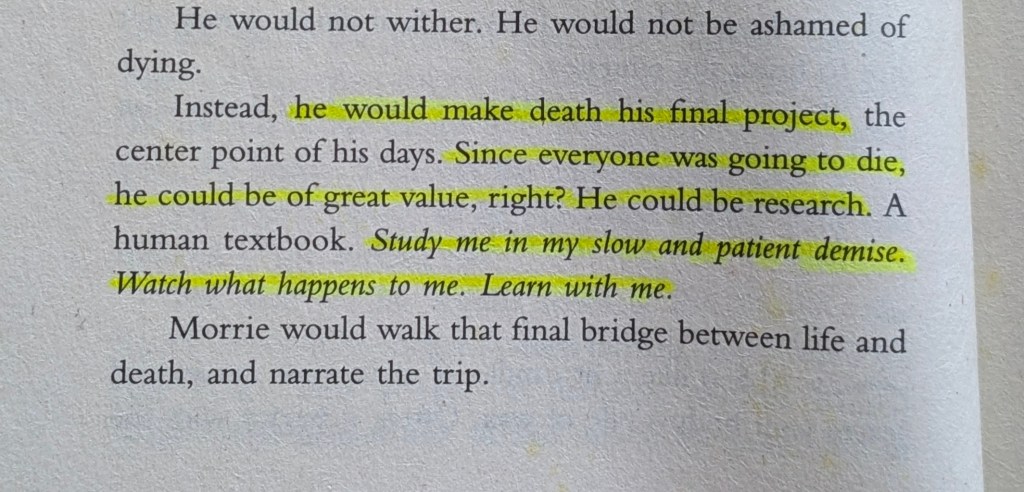
But that wasn’t the case with Morrie. He looked forward to his death. He looked forward to his death as another phase of his life that he could make the most of. Instead of drowning in sadness, he began to cherish everything he had.
He also did something that might seem a bit bizarre for many. He gathered a bunch of people and arranged his funeral just so he could hear all the nice things that people had to say about him before his departure.
This seems to be like he didn’t want to leave anything behind here, he wanted to experience every good thing before he left.
2. Being prepared for death can make you more involved in your life
This point might make you wonder, why should I be prepared for my death if I’m not fighting against a deadly disease like Morrie was? Well, it’s safe to say that no matter how healthy, rich or powerful one might be, death is inevitable.
You never know the day or the hour, but you know it’s coming, and you can only hope it’s not near. This realization can make you look at life through a different lens. It makes you live every day like it’s your last and makes you cherish every moment that you can.
Here’s what Morrie tells us on how to prepare to die –
“ Do what Buddhists do. Every day, have a little bird on your shoulder that asks, ‘Is today the day? Am I ready? Am I doing all I need to do? Am I being the person I want to be?’ “
Knowingly or not, we are too focused on materialistic things. Death shows us a lot of smaller things in life that have more value but are taken for granted most times, like health, relationships, love, etc.
3. Forgiveness
Learn to forgive and forget. Forgive yourself for the mistakes of the past and forgive others for theirs. We can never take our grudges or regrets to the grave, no matter how big they might be.
Having a deadline in his life gave Morrie the chance to correct himself.
“I mourn my dwindling time, but cherish the chances it gives me to make things right”
For us who live without this deadline, it is all the more important to correct ourselves soon. Never let your pride or ego get in the way of forgiveness.
What you’ve read till now is just a glimpse of the wisdom that there is in this book. These are three of my many takeaways. I hope this helps you the same way it helped me. Thanks for reading!
I’ve always been a fan of anything that helps me improve my productivity- books, blog posts, videos; any information that could lead to this would immediately grab my attention.
On that note, I’ve recently been reading a book called Deep Work by Mr. Cal Newport. In this post, I would like to share some of my favorite takeaways and summarize them.
What is Deep Work?
Deep work is the ability to focus without distraction on a cognitively demanding task. It is the art of nurturing our focus levels to a point where we can maximise the time that we are spending on a task.
Deep work is specifically focused on helping people get better at their crafts and improve the quality of work that they produce, which in turn adds meaning and depth to a person’s life(you will read more on that second part later in this post)
In my experience, this book was truly an eye-opener for me. It opened up so many revelations about my professional life that I hadn’t even thought of before.
It’s common sense that focus and concentration are two very important things that we need to lead a successful life. But if you would like to dive ocean deep into the world of intense focus, I would highly recommend you read this book.
While we learn about deep work, it is also important for us to understand its opposite, i.e: shallow work.
Shallow work refers to the work that can be done without needing to focus intensely, it’s something that can be performed while distracted or simultaneously with another task. These are typically the tasks which aren’t hard to do. Following the same approach for tasks that might demand a lot more would end up with poor quality of work.
Let’s talk more about why we would need to implement deep work in our lives.
This book is divided into two parts,
a) The Idea
b) The Rules
The Idea
1) Deep work is valuable
In a fast-growing economy like the one we’re living in, it’s very important for us to be good learners. As technology advances to a new level every day, it will be hard for us to thrive if we don’t keep up.
As per the author, here are the two core abilities you need to thrive in the new economy;
a) The ability to master hard things
b) The ability to produce at an elite level, in terms of both quality and speed.
Deep work helps you learn hard things quickly. We need to have intense focus and be distraction-free to learn hard things, which in other words means we need the act of deep work.
In this part of the chapter, the author points out a few scientific reasons to prove the value of deep work. He points to the fact that when we want to master hard things, our attention needs to be tightly focused on the subject we’re trying to master.
Deliberate practice cannot exist alongside distraction, it requires uninterrupted concentration
Deep work helps you produce at an elite level. The author teaches us a formula to produce high quality work:
High-quality work produced= Time spent X Intensity of focus
When we maximize our intensity when we work, we maximize the results produced per unit of time spent working. It’s more important to focus on the number of hours we spend with highly intense focus than just the number of hours we spend in the name of work.
Working in a semi-distracted state could be drastic to our performance. Whereas deep work can help us reap great benefits.
2) Deep Work Is Rare
Through this chapter, the author points out how our society has made itself prone to shallow work and how it drowns in the fallacy of it.
He mainly talks about how work environments have adapted to too many depth-free techniques like open office spaces, instant messaging between colleagues, constant meetings, and so on.
These trends are believed to give many benefits of their own, but these benefits can’t compare to the ones we get through the deep work methods.
The act of deep work seems to be rare in our community. It’s important to note that the rareness of deep work is not due to the fundamental weakness of the method, but it’s because of our flawed thinking and misconception of productive work.
Throughout this chapter, the author talks about how the rarity of deep work is a paradox. Although many business trends seem to follow the opposite of working deep and reaping numerous benefits from it, it’s important to know that individually, deep work is the best practice to follow.
3) Deep Work Is Meaningful
This next chapter is one of my favorite ones in the book. It talks about how deep work can add meaning to our lives.
Deep work is often related to craftsmanship. The author tells us that treating your work like a craft is a key to adding meaning to it.
Your work is craft, and if you hone your ability and apply it with respect and care, then you can generate meaning in the daily efforts of your professional life.
My favorite part of this chapter is how the author answers the following question :
The job I do is too mundane to be meaningful, how can I handle it?
Here’s the author’s response. People always associate career satisfaction with the job description. But the idea here is not to focus on the job we do but on how we do it.
We don’t need a rarified job; we instead need a rarified approach to our work. Deep work, therefore, is key to extract meaning from our profession
The Rules
2)Drain the shallows
The key idea here is to find out the areas in your personal or professional life where shallow work is present and try to remove it and replace it with deep work. As mentioned earlier, shallow work is anything that doesn’t demand a great amount of your focus.
The author believes that it is very important for us to be aware of how our time is spent every day so that we can get to know the actual amount of meaningful work that is getting done. This kind of analysis would further help us to eliminate unwanted things from consuming our time.
In the early parts of this chapter, the author talks about a company that switched to a 4-day workday from the standard 5 and found out that the employees could get the same amount of work done in the time span.
I found this very intriguing as someone who works in an extremely demanding work environment. How could that be possible? My work environment is like this – we are usually give a few tasks which usually require lots of analysis, finding a solution approach, implementing the solution approach and so on, and the time line is 3 weeks(5 working days a week).
And more often than not, I find that even this is not enough time for me to complete all the tasks. So, I was very curious as to how this particular company was able to pull off a 4 day work week, by working the same 8 hour shifts a day.
Here’s how the company’s co-founder explains it.
If the schedule is 8 hours a day, it doesn’t necessarily mean we work for the entire 8 hours. In most work environments, people tend to spend a lot of time attending meetings or workshops regularly. Also, some distractions can occur in between like web surfing, chit chats etc, and also there’s some time spent on lunch breaks and tea breaks.
The idea here is that fewer working hours help squeeze the fat out of a typical workweek. Once we have less time to get things done, we become more stingy with our time and won’t waste any time on things that don’t matter, hence reducing the shallow work percentage. This is a great example of how reducing shallow work can save us a lot of time.
Habits that can help drain the shallow work :
Schedule every minute of your day
This is one of the habits I’ve been practicing for a while, and let me tell you, it’s a lifesaver! Not only does this help me schedule the day better, but it also helps me not miss out on some of the minor things(like formatting work documents, filling up essential reports, etc) that may otherwise go undone in between the busy day.
The author tells us that we spend most of our day on autopilot and we don’t pay enough attention to how we spend our time. He explains that when our day is not properly scheduled, it makes way for a lot of trivial things to enter.
Here’s the suggested method from the author:
At the beginning of each workday, take a notebook and note down each line with an hour of your workday, covering all the hours you work on. Now, divide the hours into blocks and assign tasks to each block. In this way, every hour of your workday will be clearly planned before hand and can be a great guide to your workday.
Finish your work by Five Thirty
One of the most common problems that I find in most people’s lives is getting over-drained by their work schedule. This is an issue that I’ve been facing to this day. I’m writing this paragraph on a Sunday, and just two days prior to this, I had to work till 10.30 pm at night to help one of my colleagues with some pending work.
Not only does this drain all your energy and strength for the day, but it also leaves you with zero motivation for the next day, as the thought of ‘I’ve spent so much time yesterday, let me take some time off’ lingers around your mind.
To avoid this over-strain, the author suggests a method called fixed schedule productivity, which simply means, setting a particular time to close your work, and following that religiously.
He also shares a great example of Radhika Nagpal, a computer science professor at Harvard University. Noticing how unsustainable her hectic work schedule was, Nagpal decided to set a limit of fifty hours a week and worked backward to determine what was needed to satisfy this constraint.
For instance, she decided she would travel just five times per year. Which drastically reduces the workload as travel comes along with a lot of additional work. Though she reduced her workload and spent less time at work, she was still very successful in her career.
The reason behind this is she found ways to reduce all the shallow work that she had to do but continued spending all her time on deep efforts, hence advancing to great heights in her professional life.
This is a great example of how setting time limits on our workdays and tracking our work hours could yield great benefits.
3) Quit Social Media
To master the art of deep work, we need control over our time. Social media is probably the biggest enemy of this. In the author’s words, the more enticing tools you have pulling at your attention, the harder it will be to focus on something important. Therefore, we must be careful of these apps/tools that rule our attention.
The idea behind this is not to quit social media completely but to understand the threshold for allowing different websites and apps continuous access to your time and attention.
The author talks about two approaches to look into this:
a) The any benefit approach to network tool selection
This approach is about the point which most people would bring up when they are asked about taking a social media break.
In this approach, you’re justified in using a network tool if you can identify any possible benefit to its use or anything you might possibly miss out on if you don’t use it.
For example, one might say that social media is the only way to stay in touch with most of our friends we don’t get to meet often or social media is a great way to learn new things as there are a ton of excellent content creators around.
The problem with this approach is that we fail to focus on the many disadvantages that outweigh the one or few advantages that we focus on. More often than not, relationships are well maintained if you have real one-on-one conversations with the other person. And when it comes to learning, the informative content comes with thousands of other things that could mean nothing to us. So looking at it just from one angle doesn’t seem to be the best idea.
We need to understand the fact that these social media sites are engineered to be addictive. When used beyond a certain limit, we will eventually be burned out. Hence the author asks us not to use the any benefit approach to network tool selection.
Instead, he suggests another approach.
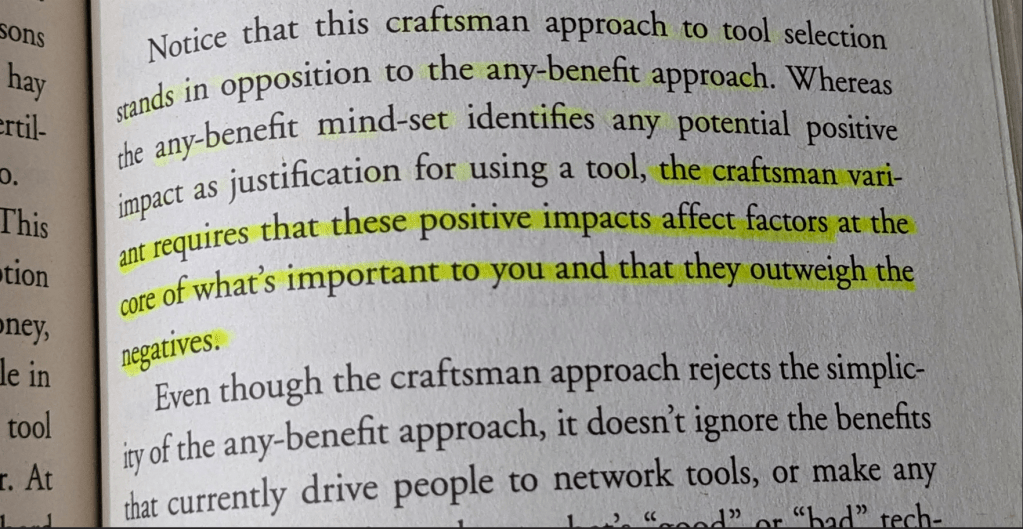
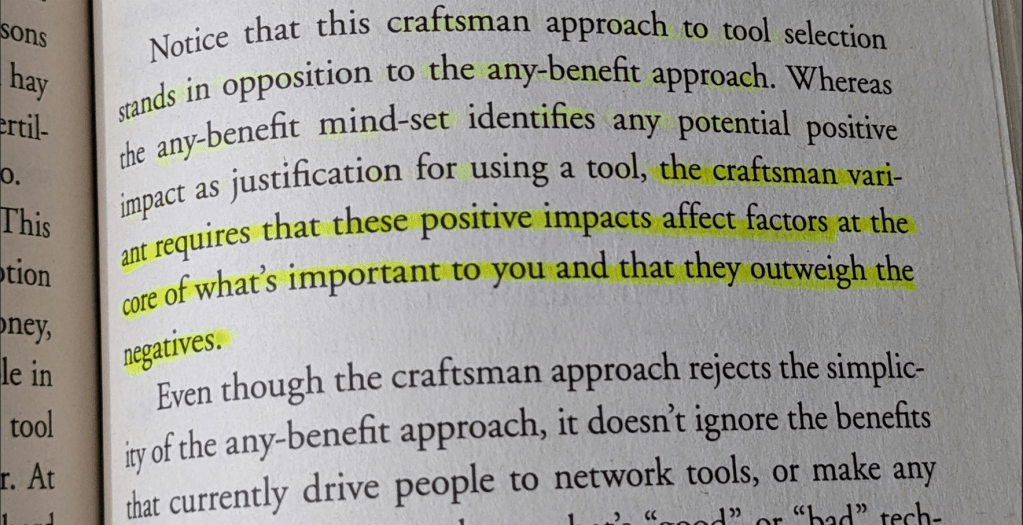
b) The craftsman approach to tool selection
Identify the core factors that determine success and happiness in your professional life and personal life. Adopt a tool only if its positive impacts on these factors substantially outweigh its negative impacts.
Instead of choosing a tool by identifying any positive impact as justification, the author asks us to analyze the ratio of positive to negative impacts the tool has on our lives. Doing so will make it easier for us to remove the tools that end up wasting our time.
This method requires a lot of time and practice to implement, and the any-benefit approach seems a lot easier, but the effort we put into analyzing these tools will yield great results when it comes to improving our deep work.
He compares this process to a craftsman choosing the perfect tool to maximize his potential. I’d suggest you read pages 188-190 to check out the amazing example of Forrest Pritchard who runs a family farm.
4) Embrace Boredom
The ability to focus, just like any other high-level skill, requires a lot of training. This particular rule ‘Embrace boredom’ talks about why and how you can train your brain to focus.
The key idea here is to reduce our dependence on distraction.
We’ve discussed a lot about the art of deep work till this point. It is important for us to not only think about implementing deep work but to also focus on how we spend our time outside of these work hours.
It’s like going through two different phases mentally. The first phase is the one which involves a deep work activity and the second one involves a distraction. The problem arises when there is a constant switch between the two.
The author talks about a study conducted by Clifford Nass, a former Stanford communications professor, who points out the effect that multitasking has on our brains. He concludes by saying that people who multitask are mental wrecks, and are chronically distracted.
If we are inclined towards distraction in every moment of boredom, we are also the same. So how do we handle boredom? how do we deal with distraction? Let’s talk more about it now.
Don’t take breaks from distraction. Instead take breaks from focus
This method asks us to schedule in advance when we will use the internet, and avoid it at other times.
Switching between a mode of distraction and a mode of concentration is a skill that many of us, including me, assume we have. The author argues that it is not that easy for our brain to switch between this mode as easily, as our brains are not wired that way.
Hence, he suggests we keep a notepad near us at work and write down the next time we’re allowed to use the internet. Until that time, no internet activity is allowed.
The key idea here is to avoid the constant switching between distraction and actual work. When we set aside a time for using the internet and try to avoid it at other times, we might easily get bored in the process and crave for the distraction again.
But through the resistance that we show using this method, we are honing our focus to be much stronger than the current level. The author says this is a type of mental training or mental calisthenics.
Work Like Teddy Roosevelt
Right from his college days, Teddy Roosevelt, the former American president, had numerous extra-curricular interests that consumed most of his time, which left him with less time to focus on his academics.
Though his attention was scattered across various things, he was still able to achieve his primary goal at the time, which was to secure good grades. The author points out that Roosevelt was able to earn honor grades in five out of his seven courses. He had a very tactical approach to time management, which was the secret to his academic success.
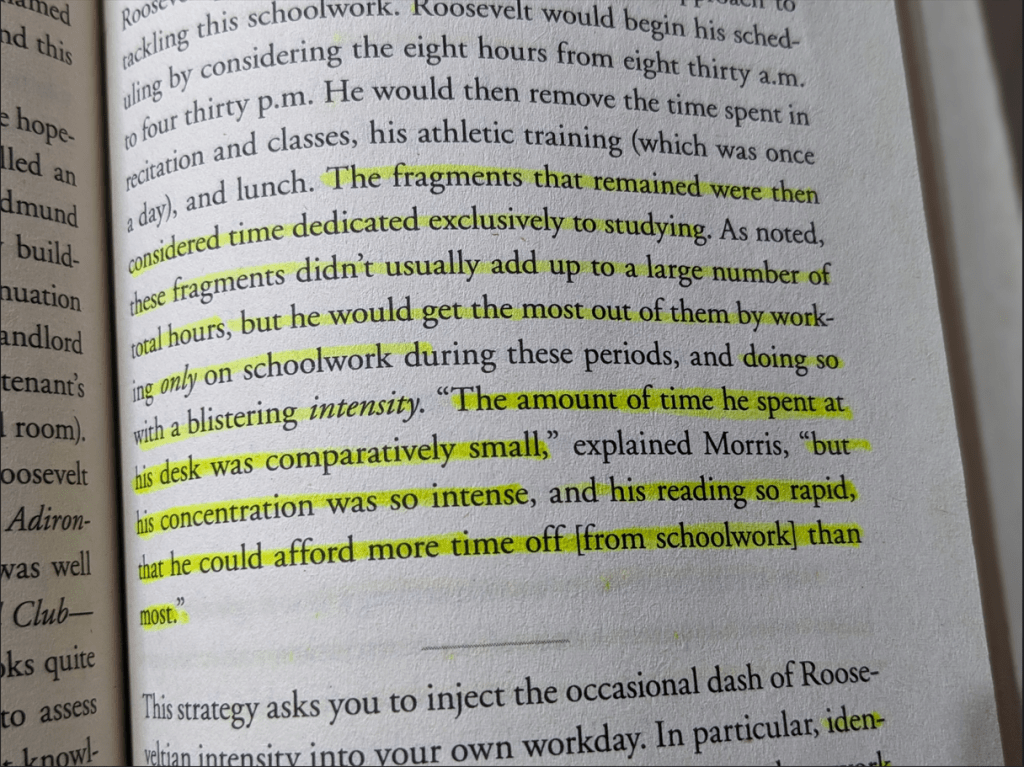
He would schedule his day from 8.30 am to 4.30pm and would remove the time spent on the unavoidables like lunch, recital classes, etc. He would then spend the rest of this time doing only schoolwork.
The key here is this. Although the time he spent on schoolwork wouldn’t add up to be a large number of hours, his concentration during this time was so intense, and his reading so rapid, that he was able to grasp all the information, and also have excess time left in the day to pursue his other interests.
What this strategy teaches us is to identify a deep task that is on top of your priority list, and estimate how long it would normally take for you to complete it, then give yourself a deadline that is drastically less than the estimated time.
In such a situation, the only way to get the task completed would be to work with great intensity. We would need to force ourselves to stay away from any type of distraction for it to work. Just like Roosevelt, attack the task with everything you’ve got.
Implementing such artificial deadlines helps us systematically increase the level of concentration that we normally achieve.
The author covers a lot of other methods to implement the rule of ‘Embrace Boredom’. I would suggest you read every part of it whenever you can.
5) Work Deeply
The title of this rule is self-explanatory. We’ve understood that deep work is a valuable asset in the current economy. But is easy to implement it in real life? No, it’s not.
There are a few reasons for this. One of the reasons is that we live world that is filled with distraction. Which also means that it is filled with a lot of shallow work. Trying to find depth in a shallow world isn’t an easy task.
Another big reason is our limited willpower. Spending most of our day in shallow work and quickly switching to a deep task because of a sudden burst of enthusiasm will never work out as a regular practice.
To help us overcome these difficulties, we need to have some strategies and routines in our quest for depth. This chapter talks about some of the best strategies that we can implement.
The Monastic Philosophy of Deep Work Scheduling
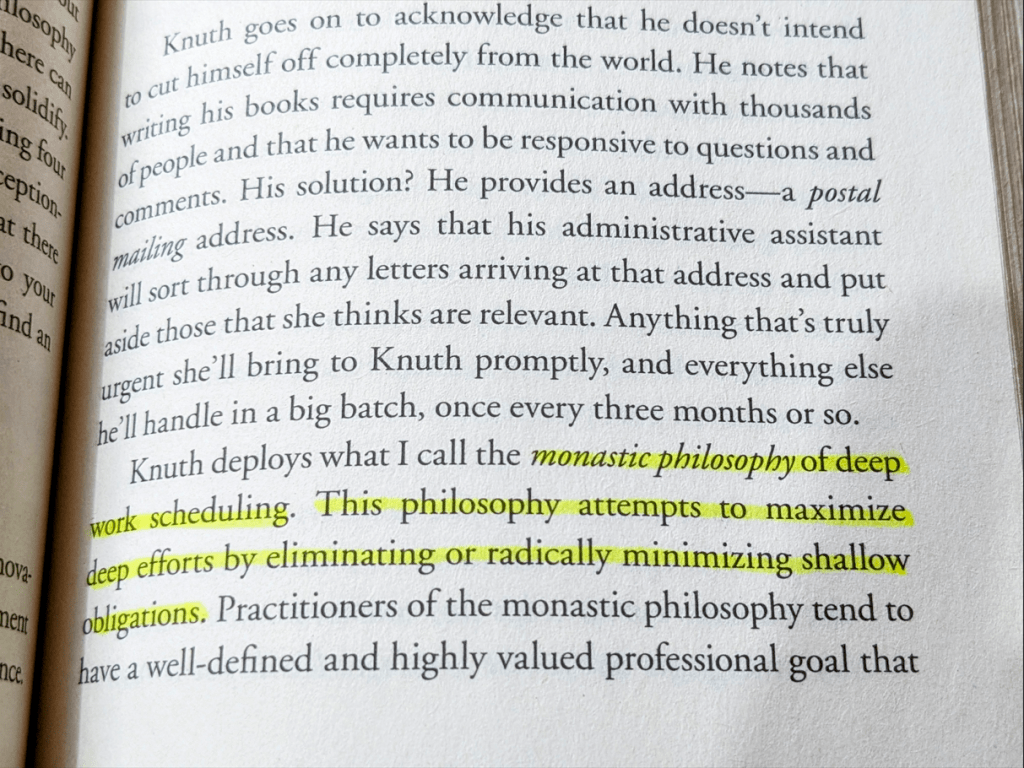
The monastic philosophy of deep work scheduling attempts to maximize deep efforts by eliminating shallow obligations.
To start the explanation, the author talks about a computer scientist named Donald Knuth, who is well known for his remarkable innovations in the world of computer science.
An interesting part of Knuth’s work ethic is his distaste for email. He claims that email is for people who always like to be on top of things, something that he could never be. His profession demands long hours of studying and uninterruptible concentration, which would be a lot harder to achieve if he had to respond to emails regularly.
The only way he allows people to contact him is through postal mail. Urgent letters would be brought to his attention promptly, while the rest would be handled in batches every few months.
By keeping himself far from shallow obligations, he is able to achieve great levels of depth professionally.
The Rhythmic Philosophy of Deep Work Scheduling
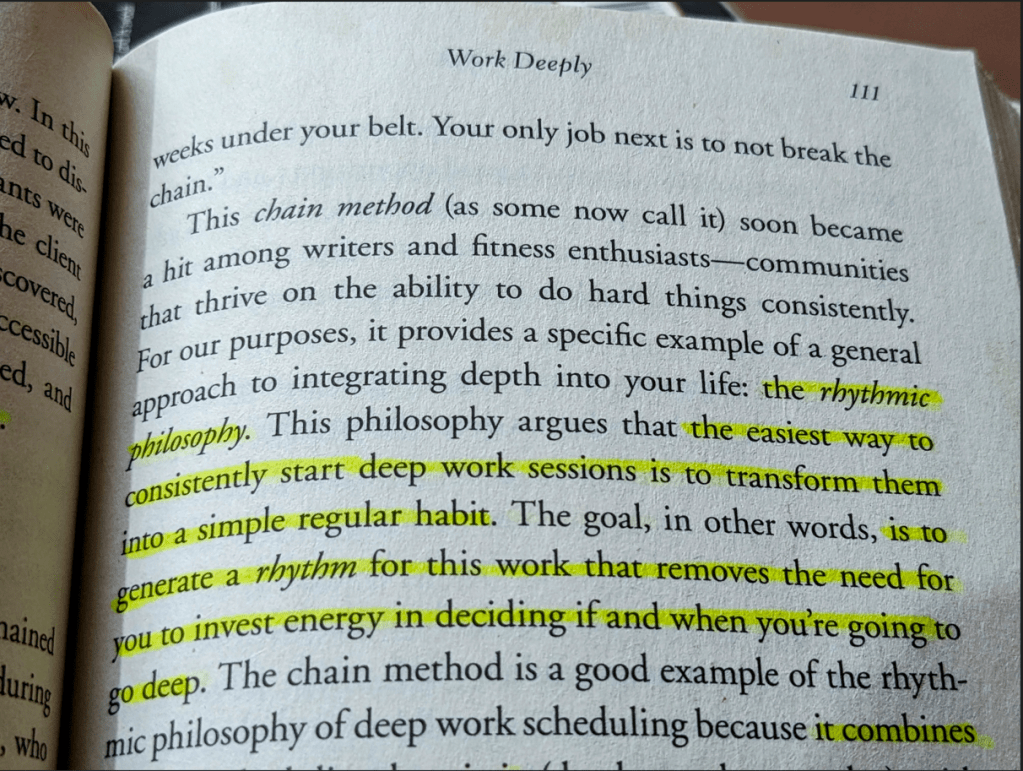
This philosophy argues that the easiest way to integrate deep work into our lives is to make it a regular habit. When we make it habitual, our schedules become more rhythmic and easier to follow.
The author talks about one of Jerry Seinfeld’s habits that he followed consistently. He keeps a calendar on his wall to track the days on which he writes jokes. Every day he writes jokes, and he crosses out the date on his calendar.
After a few days, this creates a chain. From that point on, the goal was not to break the chain and keep going.
The rhythmic philosophy teaches us the same. It’s about combining the end goal(working daily) with a way to remind yourself (cross mark on the calendar).
The author believes that this philosophy will help us log in a larger number of deep work hours by making sure that the work gets done regularly.
This book proved to be highly beneficial for my professional life, and I trust that it can also benefit yours. Thank you for reading. Have a great day!





 Wordsbykenaniah