A reminder to chase your dreams
Introduction
The title of this post is an age-old saying — perhaps the most widely used piece of advice in the world’s history. How does this advice stand the test of time? One reason is that people rarely follow it or even try to follow it. Due to life’s overwhelming nature, we often forget the biggest necessity that life demands — the pursuit of one’s dreams.
In this post, I would like to discuss Santiago, the protagonist of Paulo Coelho’s international bestseller, The Alchemist. This story is about a young boy who chases a recurring dream with all his heart and soul and, in the end, has a surprising revelation about his dream.
Short Summary
Santiago is a young shepherd from the Spanish province of Andalusia. Growing up with the ambition of travelling the world, Santiago pursued being a shepherd to move around tending his sheep.
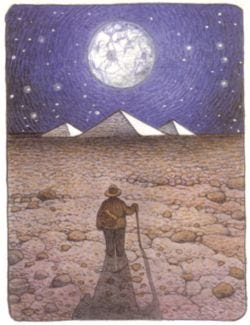
Troubled by an unfinished dream about a hidden treasure near the Egyptian pyramids, he wanted to sell his sheep and travel the world to explore the meaning of his dream. In the early days of his dream, he seeks the help of a Gypsy woman for the interpretation, but he doesn’t get the answer he was looking for.

But soon, he unexpectedly meets a wise old man, who happens to be Melchizedek, the king of Salem. Following the king’s advice, the little boy journeys toward the Egyptian pyramids.
This journey to Egypt was no easy one. It would turn his life upside down and push him to his limits. He gets off to a disastrous start when he gets robbed by a fellow in Tangier and is left with no money to continue. To make ends meet and save money to continue on his journey, he starts a job as a salesman in a crystal shop.
After saving enough money, he boards a caravan to travel through the deserts of Egypt, where he is accompanied by an Englishman in search of an alchemist. At a certain point in their journey, they stop and cool off in an oasis. Hoping that the alchemist would reside here, the Englishmen and the boy go in search of him.
In this pursuit, Santiago meets a beautiful girl named Fatima and falls in love instantly. He conveys his love for her and proposes marriage. They develop a great relationship in the oasis, and their life as a couple blossoms into a meaningful one until Santiago has to resume his journey to the pyramids.
Amidst the never-ending journey of the wilderness, the boy had learned to read omens and to listen to his heart more clearly. In one such instance, his ability to read an omen saves the oasis from an enemy attack. It was during this time that he met with the alchemist.
They converse about the boy’s journey from the pastures of Andalusia to Egypt, and the Alchemist decides to come along with him on his journey. The lion’s share of their conversation was about listening to your heart and staying true to its path.
Three hours away from the pyramids, the Alchemist bids goodbye to the boy and sends him on his way with some gold for him to use. This was the first time that Santiago had witnessed the power of alchemy, as he stood next to the alchemist turning lead into gold.
Though the boy parted ways with him, the alchemist’s words were now etched in his heart forever. As he journeyed closer and closer to the treasure, his words kept echoing inside of him.
When he finally arrived at the location of the treasure, the boy started digging into the dunes. A big twist in the tale awaits. He is caught off guard by the sound of a few footsteps approaching. They were refugees from the tribal wars, and they started enquiring about the boy’s actions.
The boy reveals his mysterious secret, and is met with a spine-chilling response. One of the men looks at him and says that he once had a recurrent dream too, from the same location they were at. He dreamed that he should travel to the fields of Spain and look for a ruined church where shepherds and their sheep slept. He thought that he might find a treasure there under the roots of a sycamore tree. He said he was too stupid to cross a desert because of a dream.
The sycamore tree in that ruined church was the exact place where the boy had had the dream. Soon, he travels back to Spain to visit that church and starts digging for his treasure. He finds a chest of Spanish gold coins and precious stones, and statues embedded with jewels. They were the forgotten spoils of a past conquest.
Even after realising the biggest dream of his life, his heart still yearned for a greater treasure, as the wind brought the scent of Fatima’s perfume.
Lessons from the book
- Be ten toes down with your dream. Chase it with all you’ve got
If there’s one thing to take away from this book, it would be this. A lowly shepherd from Spain threw everything away and decided to take on the most gruesome journey of his life with little to no prior knowledge of it, all for the sake of his dream.
I loved how the boy faced adversaries on his journey. There were certain points in his journey, when he was up against mighty men whom he assumed were to attack him, he had a strange sense of joy, knowing that he could die in pursuit of his destiny. He considered such death to be a privilege. What a strange yet powerful view on destiny!
2. When a person desires something, all the universe conspires to help that person realise their dream.
This phrase is repeated many times in the book. What I understand is that the world favours the man who tries the most. I think of it as simple math: The more you try, the more likely you are to succeed.
Santiago’s desire to fulfil his destiny was no joke. He sold all his sheep to gather the money, got robbed twice on his journey, had his journey halted in a strange land and had to hustle to regain his path, got into the middle of the desert during the time of war, left the love of his life back to continue his journey, and met with the biggest surprise at the end of it all.
The fascinating part of all this is that he kept going. None of the hardships could put a full stop to his journey. The difference between the man who has the universe on his side and the man who doesn’t is the difference between Santiago and the refugee. Both had the same dream, but only one was ready to achieve it.
It’s probably the most influential book I’ve ever read. It empowered my dreamer spirit and validated my suffering. If Santiago could suffer, survive and claim his treasure, then so could I. – Will Smith on his memoir
As the title of this post says, this book stands as a reminder to chase our dreams. Paulo Coelho has beautifully articulated the journey of chasing your dream with a sense of delusion, which he compares with the art of alchemy — the magical ability to change lead to gold, leading us to believe that life in itself is a type of alchemy, meaning you can be anything you put your mind to be, and fulfil any dream. This book has planted a great amount of self-belief in me, and I hope it will do the same to you.
Hope you liked reading this post. If you are already a fan of this book, do let me know in the comments how this book helped you. Also, you can share your thoughts on your journey chasing your dreams.
Thank you!
 Wordsbykenaniah