Introduction
Elderly advice is an interesting subject to deal with. As children and as young adults, we despise it, but as we mature with age, we crave it a lot more. I believe this to be true in most cases, most definitely in mine.
As a 25-year-old, I crave the sound wisdom of the elderly. Especially when it comes to finding happiness and success. But I still remember the days I hated hearing advice. I still remember trying to distance myself from people who constantly shared their experiences and life lessons, and I’m glad to know I’m not that same person now.
In this post, I would like to talk about Tuesdays with Morrie, a book that revolves around the life of a dying ex-professor and his former student who spent a lot of time together discussing life.

It’s the story of how a student-teacher relationship found itself back in a classroom setting and soon blossomed into a father-son kind of relationship.
Short Summary
The author of this book, Mitch Albom was a columnist for the Detroit Free Press. Morrie Schwartz, who the whole book is based on, was Albom’s ex-professor at Brandeis University. In August of 1994, Morrie began the fight with the biggest challenge of his life when he was diagnosed with ALS(amyotrophic lateral sclerosis).
Many years after graduating college, Mitch Albom learns about his professor’s fight with ALS through a television show. To Albom’s surprise, he heard Morrie Schwartz on TV while flipping channels on a random day.
Here’s a little backstory on how Morrie ended up on TV. Morrie had this habit of jotting down his thoughts on different kinds of pads, papers envelopes, etc. These were aphorisms on living close by to death. Amazed by his writings, a fellow Brandeis professor sent them to a reporter who came out and wrote a long feature story on Morrie.
When this article caught the eye of the producer of the Nightline show, he decided to do an interview with Morrie. In March of 1995, the camera crew arrived at Morrie’s house to shoot the interview.
As soon as he found out about Morrie, Albom wanted to pay a visit to his ex-professor and check on his health. They embraced each other with the warm teacher-student love that they had shared many years ago.
After a wonderful conversation, Albom decides to catch up with Morrie whenever he can as he loves the conversations about life.
Remembering the classes they had on Tuesdays back in college, they decided to meet every Tuesday going forth.
This book talks about the 14 Tuesdays that they spent together and the valuable life lessons that Morrie wanted to share with the world.
Let’s dive deeper into this book and look at some of the best life lessons that we can learn from Morrie.
The topic of discussion for the 14 Tuesdays
- The world
- Feeling sorry for yourself
- Regrets
- Death
- Family
- Emotions
- Fear of aging
- Money
- How love goes on
- Marriage
- Our Culture
- Forgiveness
- The perfect day
- Goodbye
Key Takeaways
- Facing adversaries with a positive attitude
One of the things that I loved about this book was Morrie’s perspective on the whole situation. Diagnosed with a deadly disease, and living with the anticipation of helplessness and death, one would usually expect the person to crumble in fear and sadness every day.
But that wasn’t the case with Morrie. He looked forward to his death. He looked forward to his death as another phase of his life that he could make the most of. Instead of drowning in sadness, he began to cherish everything he had.
He also did something that might seem a bit bizarre for many. He gathered a bunch of people and arranged his funeral just so he could hear all the nice things that people had to say about him before his departure.
This seems to be like he didn’t want to leave anything behind here, he wanted to experience every good thing before he left.
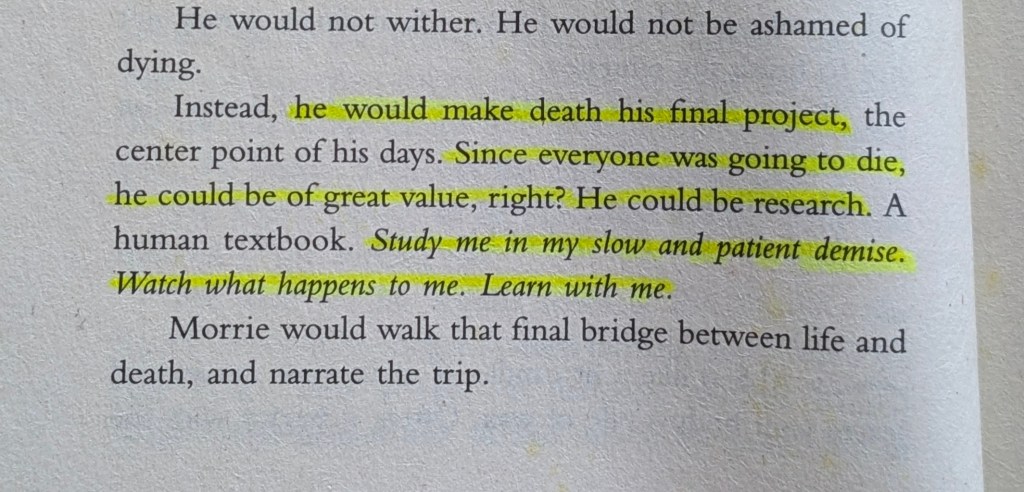
2. Being prepared for death can make you more involved in your life
This point might make you wonder, why should I be prepared for my death if I’m not fighting against a deadly disease like Morrie was? Well, it’s safe to say that no matter how healthy, rich or powerful one might be, death is inevitable.
You never know the day or the hour, but you know it’s coming, and you can only hope it’s not near. This realization can make you look at life through a different lens. It makes you live every day like it’s your last and makes you cherish every moment that you can.
Here’s what Morrie tells us on how to prepare to die –
“ Do what Buddhists do. Every day, have a little bird on your shoulder that asks, ‘Is today the day? Am I ready? Am I doing all I need to do? Am I being the person I want to be?’ “
Knowingly or not, we are too focused on materialistic things. Death shows us a lot of smaller things in life that have more value but are taken for granted most times, like health, relationships, love, etc.

3. Forgiveness
Learn to forgive and forget. Forgive yourself for the mistakes of the past and forgive others for theirs. We can never take our grudges or regrets to the grave, no matter how big they might be.
Having a deadline in his life gave Morrie the chance to correct himself.
“I mourn my dwindling time, but cherish the chances it gives me to make things right”
For us who live without this deadline, it is all the more important to correct ourselves soon. Never let your pride or ego get in the way of forgiveness.

What you’ve read till now is just a glimpse of the wisdom that there is in this book. These are three of my many takeaways. I hope this helps you the same way it helped me. Thanks for reading!
 Wordsbykenaniah