Jermaine Cole, one of my favourite rappers ever, said this line in a song that I heard recently –
One thing about this money –
it’s easy to get
but trust me, my brother, it’s hard to keep
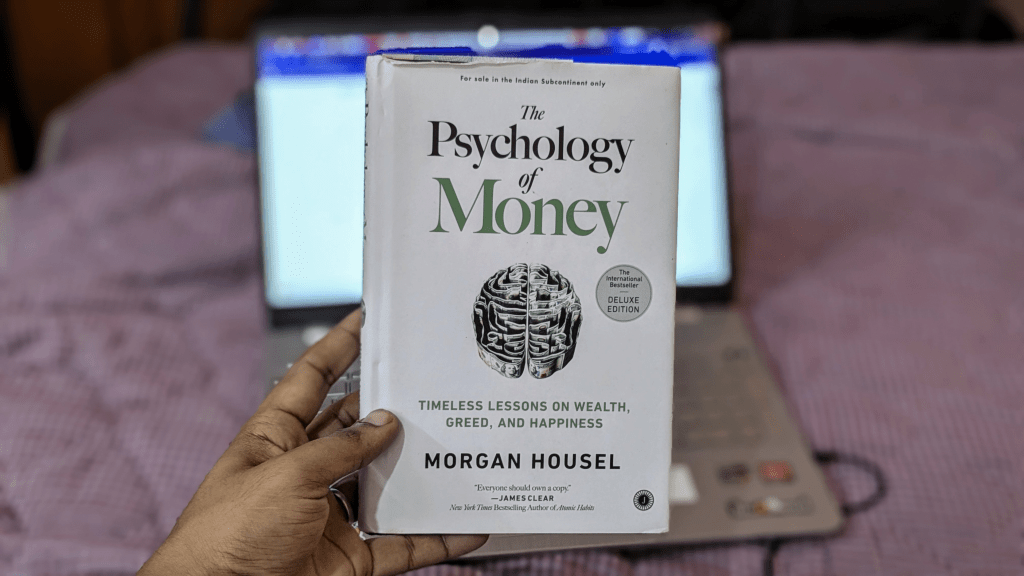
This line hit me hard when I heard it the first time, and it quickly reminded me of the book I’m about to write about today — ‘The Psychology of Money’ by Morgan Housel.
It’s easily one of the most hyped books I’ve ever heard of, almost making me wonder if the hype would lessen the beauty of this book when I decide to read it, but trust me folks, it lived up to every bit of it.
People usually pay a lot of attention to fallacies when it comes to money. If I come out tomorrow and say I have found a way to double your money in a week easily, many people will have their ears glued to me.
But if I talk about ways to understand how money really works and how it grows steadily, they won’t even pay attention. People love quick relief but hate the long-term solution.
What I love about this book is the way the author breaks this barrier and explains the psychological aspect of money in the simplest way possible. Though it’s not a get-rich-quick kind of book, it will have you hooked in no time.
Now that I’ve talked about the book enough, and hopefully motivated you to pick it up instantly, let’s dive into some of my favourite lessons from it.
1) Keep your expectations steady when you grow your money
One of the most hard-hitting pointers from this book is this — The hardest financial skill is getting the goalpost to stop moving.
If our goalpost(our expectations and needs) keeps moving ahead with money, then no amount of money can give us satisfaction because we will always end up wanting more. I was able to connect with this logic because I’ve faced the same in my life. When I started earning, I had the habit of writing down all my expenses on a sheet of paper and planning on how to spend money wisely.
At first, I used to think, if I could earn a few thousand more, my life could be a lot better now. And then when I started earning more, it was the same feeling again, because my expense list started getting longer as I started earning more money. That’s when I realized that the problem was with me and my spending habits. Soon I was able to change it and control my expenses.
The first takeaway that you need from this book is this — stop the goalpost from moving. Morgan Housel said it best :
Happiness, as it’s said, is just results minus expectations.
2) Compounding is the secret Recipe
Compounding is probably the most cliched term in the world of financial literacy. But it is so for a reason. It is the secret sauce that you need to perfect your wealth creation journey.
The author points out a great example, the story of Warren Buffet. Warren started investing at the age of 10 and continued his journey over 7 decades. The key here is the amount of time that he stayed in the game and not the percentage of returns generated(although he was able to grow his money at a whopping 22% annually).
To put that into perspective, had he stopped investing at at age of sixty, having earned the same 22% returns, his net worth would have been just $11.9 million as compared to his net worth at the time of this book which is $84.5 Billion!
$81.5 billion of Warren Buffet’s $84.5 billion networth(at the time of writing this book) came after his 65th birthday. These staggering numbers are only because of the power of compounding.
Good investing isn’t necessarily about earning the highest returns. It’s about earning pretty good returns that you can stick with and which can be repeated for the longest period of time. That’s when compounding runs wild.
3) Getting wealthy vs Staying wealthy
Let’s go back to the opening block of this post where I shared a song lyric that told us that making money is one thing, but keeping it is the hard part.
Think about how many real-life examples come to your mind. I’ve seen many of these cases happen with athletes mostly, and every time I hear such news I’m surprised at how they manage to go broke after earning all that money.
If you didn’t already know, Mike Tyson is a famous example.
So how do these rich people end up broke? How can we avoid it?
The author tells us that if he would summarize money success in a single word it would be “survival”.
“Survival” means the ability to stick around for a long time, without being forced to give up. Because in the game of money, the ones who stay in the game long enough are the ones who reap the benefits.
Let’s take Warren Buffet as an example again. Look at what he had to go through in his investing journey.
He didn’t panic and sell during the 14 recessions. He didn’t sully his business reputation. He didn’t attach himself to one business strategy or passing trend. He didn’t burn himself out. He survived for 7 decades! And that incredible combo of longevity + compounding is what made him wealthy.
Survival means appreciating 3 things:
- More than big returns, I want to be financially unbreakable → Merely good returns sustained uninterrupted for the longest period — especially in times of chaos will always win.
- Planning is important, but the most important part of every plan is to plan on the plan not going according to plan -> A good plan emphasizes room for error. If there is enough room for error in your savings, you will be happy no matter how the market condition is.
- Be optimistic about the future, but paranoid about what will prevent you from getting to the future -> Sensible optimism is better than just optimism. Sensible optimism is believing that all things will work out fine in the end, but the path to it will be filled with landmines. It’s important to accept these situations and still be optimistic.
4) Wealth is what you don’t see
It’s important to understand the difference between ‘Rich’ and ‘Wealthy’. ‘Rich’ is the current income, and ‘wealth’ is the financial assets that haven’t yet been converted into stuff you see.
Ironically, spending money to look rich is the fastest way to become poor. When people try to look rich, they often end up spending the money that they don’t have as the money they do have is not enough.
Wealth is an option not yet taken to buy something later. Its value lies in offering options, flexibility,and growth to one day purchase more stuff than you could get right now.
5) Reasonable > Rational
Do not aim to be coldly rational when making financial decisions. Aim to be just pretty reasonable.
Rational investors make decisions based on numeric facts and the strategies that they believe to be helpful. However, reasonable investors make decisions based on realistic aspects.
To give you an example, a rational investing strategy may say that you have a 60–40 chance of making big money, and the rational investor would just look at the bright side and jump in head first. However, a reasonable investor will look at the impact that the downside might have.
If the strategy fails, and chances are that it might, how big is the impact? If it affects the happiness of my family, or if it puts the future of my kids in danger, then it’s not for me.
Another key point is, that although reasonable strategies may sometimes be technically imperfect, they are more likely to stick around for the long run, which as we already talked about, is an important factor in financial success.
These were some of my biggest takeaways from this book. Hope you liked reading this. Thank you for your time. Make sure to follow and share!
 Wordsbykenaniah