I’ve always been a fan of anything that helps me improve my productivity- books, blog posts, videos; any information that could lead to this would immediately grab my attention.
On that note, I’ve recently been reading a book called Deep Work by Mr. Cal Newport. In this post, I would like to share some of my favorite takeaways and summarize them.

What is Deep Work?
Deep work is the ability to focus without distraction on a cognitively demanding task. It is the art of nurturing our focus levels to a point where we can maximise the time that we are spending on a task.
Deep work is specifically focused on helping people get better at their crafts and improve the quality of work that they produce, which in turn adds meaning and depth to a person’s life(you will read more on that second part later in this post)
In my experience, this book was truly an eye-opener for me. It opened up so many revelations about my professional life that I hadn’t even thought of before.
It’s common sense that focus and concentration are two very important things that we need to lead a successful life. But if you would like to dive ocean deep into the world of intense focus, I would highly recommend you read this book.
While we learn about deep work, it is also important for us to understand its opposite, i.e: shallow work.
Shallow work refers to the work that can be done without needing to focus intensely, it’s something that can be performed while distracted or simultaneously with another task.
These are typically the tasks which aren’t hard to do. Following the same approach for tasks that might demand a lot more would end up with poor quality of work.
Let’s talk more about why we would need to implement deep work in our lives.
This book is divided into two parts,
a) The Idea
b) The Rules
The Idea
1) Deep work is valuable
In a fast-growing economy like the one we’re living in, it’s very important for us to be good learners. As technology advances to a new level every day, it will be hard for us to thrive if we don’t keep up.
As per the author, here are the two core abilities you need to thrive in the new economy;
a) The ability to master hard things
b) The ability to produce at an elite level, in terms of both quality and speed.
Deep work helps you learn hard things quickly. We need to have intense focus and be distraction-free to learn hard things, which in other words means we need the act of deep work.
In this part of the chapter, the author points out a few scientific reasons to prove the value of deep work. He points to the fact that when we want to master hard things, our attention needs to be tightly focused on the subject we’re trying to master.
Deliberate practice cannot exist alongside distraction, it requires uninterrupted concentration
Deep work helps you produce at an elite level. The author teaches us a formula to produce high quality work:
High-quality work produced= Time spent X Intensity of focus
When we maximize our intensity when we work, we maximize the results produced per unit of time spent working. It’s more important to focus on the number of hours we spend with highly intense focus than just the number of hours we spend in the name of work.
Working in a semi-distracted state could be drastic to our performance. Whereas deep work can help us reap great benefits.
2) Deep Work Is Rare
Through this chapter, the author points out how our society has made itself prone to shallow work and how it drowns in the fallacy of it.
He mainly talks about how work environments have adapted to too many depth-free techniques like open office spaces, instant messaging between colleagues, constant meetings, and so on.
These trends are believed to give many benefits of their own, but these benefits can’t compare to the ones we get through the deep work methods.
The act of deep work seems to be rare in our community. It’s important to note that the rareness of deep work is not due to the fundamental weakness of the method, but it’s because of our flawed thinking and misconception of productive work.
Throughout this chapter, the author talks about how the rarity of deep work is a paradox. Although many business trends seem to follow the opposite of working deep and reaping numerous benefits from it, it’s important to know that individually, deep work is the best practice to follow.
3) Deep Work Is Meaningful
This next chapter is one of my favorite ones in the book. It talks about how deep work can add meaning to our lives.
Deep work is often related to craftsmanship. The author tells us that treating your work like a craft is a key to adding meaning to it.
Your work is craft, and if you hone your ability and apply it with respect and care, then you can generate meaning in the daily efforts of your professional life.
My favorite part of this chapter is how the author answers the following question :
The job I do is too mundane to be meaningful, how can I handle it?
Here’s the author’s response. People always associate career satisfaction with the job description. But the idea here is not to focus on the job we do but on how we do it.
We don’t need a rarified job; we instead need a rarified approach to our work. Deep work, therefore, is key to extract meaning from our profession
The Rules
2)Drain the shallows
The key idea here is to find out the areas in your personal or professional life where shallow work is present and try to remove it and replace it with deep work. As mentioned earlier, shallow work is anything that doesn’t demand a great amount of your focus.
The author believes that it is very important for us to be aware of how our time is spent every day so that we can get to know the actual amount of meaningful work that is getting done. This kind of analysis would further help us to eliminate unwanted things from consuming our time.
In the early parts of this chapter, the author talks about a company that switched to a 4-day workday from the standard 5 and found out that the employees could get the same amount of work done in the time span.
I found this very intriguing as someone who works in an extremely demanding work environment. How could that be possible? My work environment is like this – we are usually give a few tasks which usually require lots of analysis, finding a solution approach, implementing the solution approach and so on, and the time line is 3 weeks(5 working days a week).
And more often than not, I find that even this is not enough time for me to complete all the tasks. So, I was very curious as to how this particular company was able to pull off a 4 day work week, by working the same 8 hour shifts a day.
Here’s how the company’s co-founder explains it.
If the schedule is 8 hours a day, it doesn’t necessarily mean we work for the entire 8 hours. In most work environments, people tend to spend a lot of time attending meetings or workshops regularly. Also, some distractions can occur in between like web surfing, chit chats etc, and also there’s some time spent on lunch breaks and tea breaks.
The idea here is that fewer working hours help squeeze the fat out of a typical workweek. Once we have less time to get things done, we become more stingy with our time and won’t waste any time on things that don’t matter, hence reducing the shallow work percentage. This is a great example of how reducing shallow work can save us a lot of time.
Habits that can help drain the shallow work :
Schedule every minute of your day
This is one of the habits I’ve been practicing for a while, and let me tell you, it’s a lifesaver! Not only does this help me schedule the day better, but it also helps me not miss out on some of the minor things(like formatting work documents, filling up essential reports, etc) that may otherwise go undone in between the busy day.
The author tells us that we spend most of our day on autopilot and we don’t pay enough attention to how we spend our time. He explains that when our day is not properly scheduled, it makes way for a lot of trivial things to enter.
Here’s the suggested method from the author:
At the beginning of each workday, take a notebook and note down each line with an hour of your workday, covering all the hours you work on. Now, divide the hours into blocks and assign tasks to each block. In this way, every hour of your workday will be clearly planned before hand and can be a great guide to your workday.
Finish your work by Five Thirty
One of the most common problems that I find in most people’s lives is getting over-drained by their work schedule. This is an issue that I’ve been facing to this day. I’m writing this paragraph on a Sunday, and just two days prior to this, I had to work till 10.30 pm at night to help one of my colleagues with some pending work.
Not only does this drain all your energy and strength for the day, but it also leaves you with zero motivation for the next day, as the thought of ‘I’ve spent so much time yesterday, let me take some time off’ lingers around your mind.
To avoid this over-strain, the author suggests a method called fixed schedule productivity, which simply means, setting a particular time to close your work, and following that religiously.
He also shares a great example of Radhika Nagpal, a computer science professor at Harvard University. Noticing how unsustainable her hectic work schedule was, Nagpal decided to set a limit of fifty hours a week and worked backward to determine what was needed to satisfy this constraint.
For instance, she decided she would travel just five times per year. Which drastically reduces the workload as travel comes along with a lot of additional work. Though she reduced her workload and spent less time at work, she was still very successful in her career.
The reason behind this is she found ways to reduce all the shallow work that she had to do but continued spending all her time on deep efforts, hence advancing to great heights in her professional life.
This is a great example of how setting time limits on our workdays and tracking our work hours could yield great benefits.
3) Quit Social Media
To master the art of deep work, we need control over our time. Social media is probably the biggest enemy of this. In the author’s words, the more enticing tools you have pulling at your attention, the harder it will be to focus on something important. Therefore, we must be careful of these apps/tools that rule our attention.
The idea behind this is not to quit social media completely but to understand the threshold for allowing different websites and apps continuous access to your time and attention.
The author talks about two approaches to look into this:
a) The any benefit approach to network tool selection
This approach is about the point which most people would bring up when they are asked about taking a social media break.
In this approach, you’re justified in using a network tool if you can identify any possible benefit to its use or anything you might possibly miss out on if you don’t use it.
For example, one might say that social media is the only way to stay in touch with most of our friends we don’t get to meet often or social media is a great way to learn new things as there are a ton of excellent content creators around.
The problem with this approach is that we fail to focus on the many disadvantages that outweigh the one or few advantages that we focus on. More often than not, relationships are well maintained if you have real one-on-one conversations with the other person. And when it comes to learning, the informative content comes with thousands of other things that could mean nothing to us. So looking at it just from one angle doesn’t seem to be the best idea.
We need to understand the fact that these social media sites are engineered to be addictive. When used beyond a certain limit, we will eventually be burned out. Hence the author asks us not to use the any benefit approach to network tool selection.
Instead, he suggests another approach.
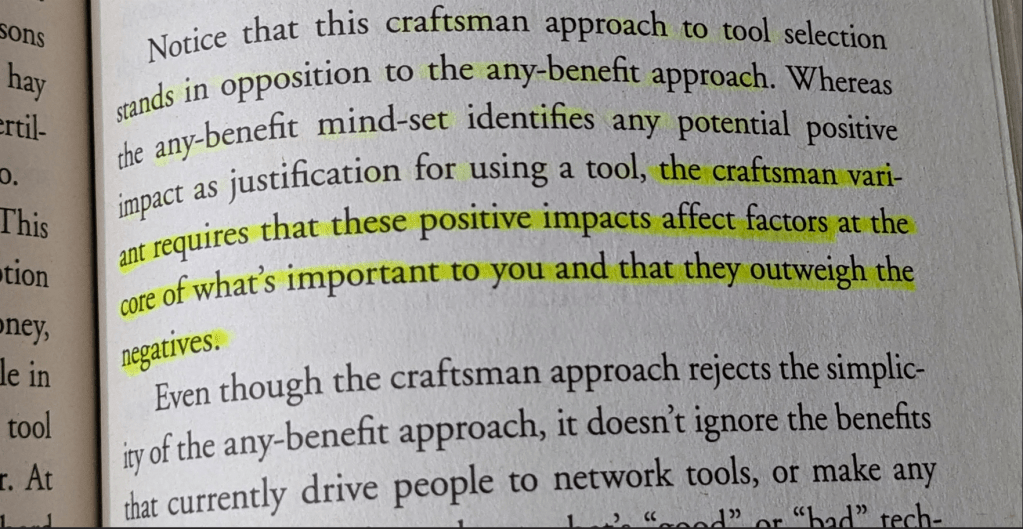
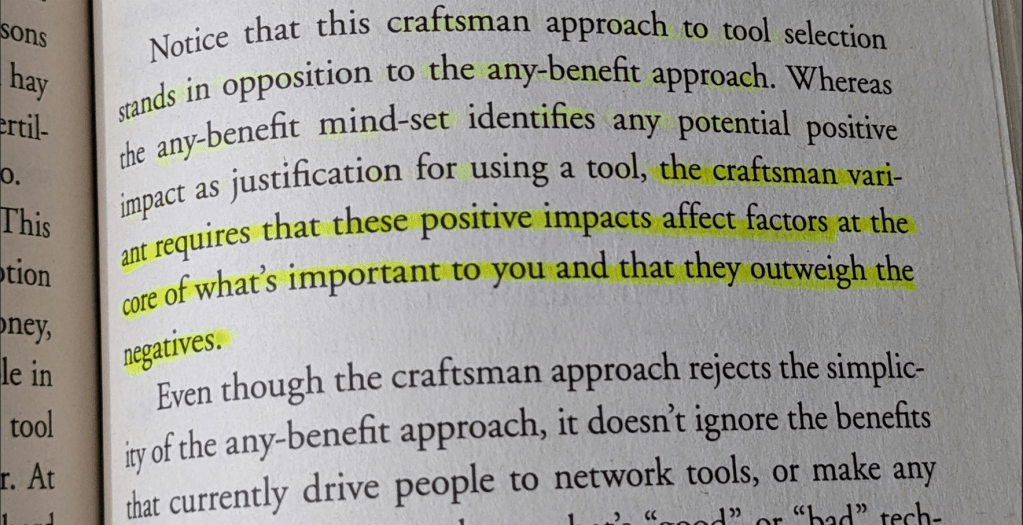
b) The craftsman approach to tool selection
Identify the core factors that determine success and happiness in your professional life and personal life. Adopt a tool only if its positive impacts on these factors substantially outweigh its negative impacts.
Instead of choosing a tool by identifying any positive impact as justification, the author asks us to analyze the ratio of positive to negative impacts the tool has on our lives. Doing so will make it easier for us to remove the tools that end up wasting our time.
This method requires a lot of time and practice to implement, and the any-benefit approach seems a lot easier, but the effort we put into analyzing these tools will yield great results when it comes to improving our deep work.
He compares this process to a craftsman choosing the perfect tool to maximize his potential. I’d suggest you read pages 188-190 to check out the amazing example of Forrest Pritchard who runs a family farm.
4) Embrace Boredom
The ability to focus, just like any other high-level skill, requires a lot of training. This particular rule ‘Embrace boredom’ talks about why and how you can train your brain to focus.
The key idea here is to reduce our dependence on distraction.
We’ve discussed a lot about the art of deep work till this point. It is important for us to not only think about implementing deep work but to also focus on how we spend our time outside of these work hours.
It’s like going through two different phases mentally. The first phase is the one which involves a deep work activity and the second one involves a distraction. The problem arises when there is a constant switch between the two.
The author talks about a study conducted by Clifford Nass, a former Stanford communications professor, who points out the effect that multitasking has on our brains. He concludes by saying that people who multitask are mental wrecks, and are chronically distracted.
If we are inclined towards distraction in every moment of boredom, we are also the same. So how do we handle boredom? how do we deal with distraction? Let’s talk more about it now.
- Don’t take breaks from distraction. Instead take breaks from focus
This method asks us to schedule in advance when we will use the internet, and avoid it at other times.
Switching between a mode of distraction and a mode of concentration is a skill that many of us, including me, assume we have. The author argues that it is not that easy for our brain to switch between this mode as easily, as our brains are not wired that way.
Hence, he suggests we keep a notepad near us at work and write down the next time we’re allowed to use the internet. Until that time, no internet activity is allowed.
The key idea here is to avoid the constant switching between distraction and actual work. When we set aside a time for using the internet and try to avoid it at other times, we might easily get bored in the process and crave for the distraction again.
But through the resistance that we show using this method, we are honing our focus to be much stronger than the current level. The author says this is a type of mental training or mental calisthenics.
- Work Like Teddy Roosevelt
Right from his college days, Teddy Roosevelt, the former American president, had numerous extra-curricular interests that consumed most of his time, which left him with less time to focus on his academics.
Though his attention was scattered across various things, he was still able to achieve his primary goal at the time, which was to secure good grades. The author points out that Roosevelt was able to earn honor grades in five out of his seven courses. He had a very tactical approach to time management, which was the secret to his academic success.
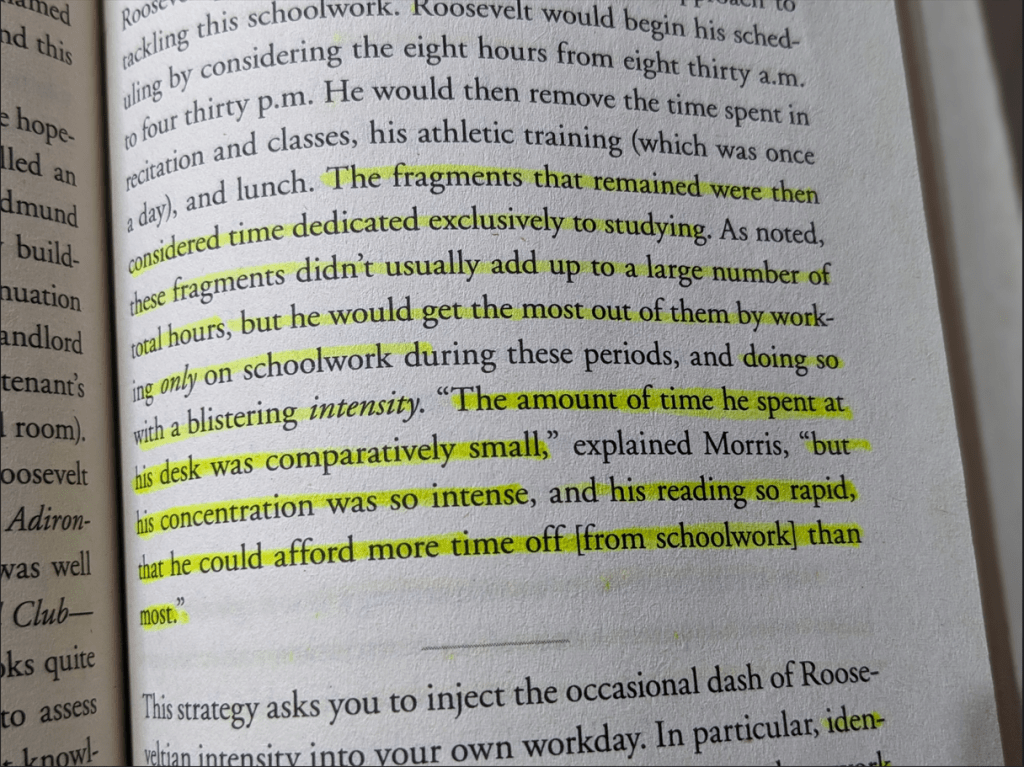
He would schedule his day from 8.30 am to 4.30pm and would remove the time spent on the unavoidables like lunch, recital classes, etc. He would then spend the rest of this time doing only schoolwork.
The key here is this. Although the time he spent on schoolwork wouldn’t add up to be a large number of hours, his concentration during this time was so intense, and his reading so rapid, that he was able to grasp all the information, and also have excess time left in the day to pursue his other interests.
What this strategy teaches us is to identify a deep task that is on top of your priority list, and estimate how long it would normally take for you to complete it, then give yourself a deadline that is drastically less than the estimated time.
In such a situation, the only way to get the task completed would be to work with great intensity. We would need to force ourselves to stay away from any type of distraction for it to work. Just like Roosevelt, attack the task with everything you’ve got.
Implementing such artificial deadlines helps us systematically increase the level of concentration that we normally achieve.
The author covers a lot of other methods to implement the rule of ‘Embrace Boredom’. I would suggest you read every part of it whenever you can.
5) Work Deeply
The title of this rule is self-explanatory. We’ve understood that deep work is a valuable asset in the current economy. But is easy to implement it in real life? No, it’s not.
There are a few reasons for this. One of the reasons is that we live world that is filled with distraction. Which also means that it is filled with a lot of shallow work. Trying to find depth in a shallow world isn’t an easy task.
Another big reason is our limited willpower. Spending most of our day in shallow work and quickly switching to a deep task because of a sudden burst of enthusiasm will never work out as a regular practice.
To help us overcome these difficulties, we need to have some strategies and routines in our quest for depth. This chapter talks about some of the best strategies that we can implement.
The Monastic Philosophy of Deep Work Scheduling
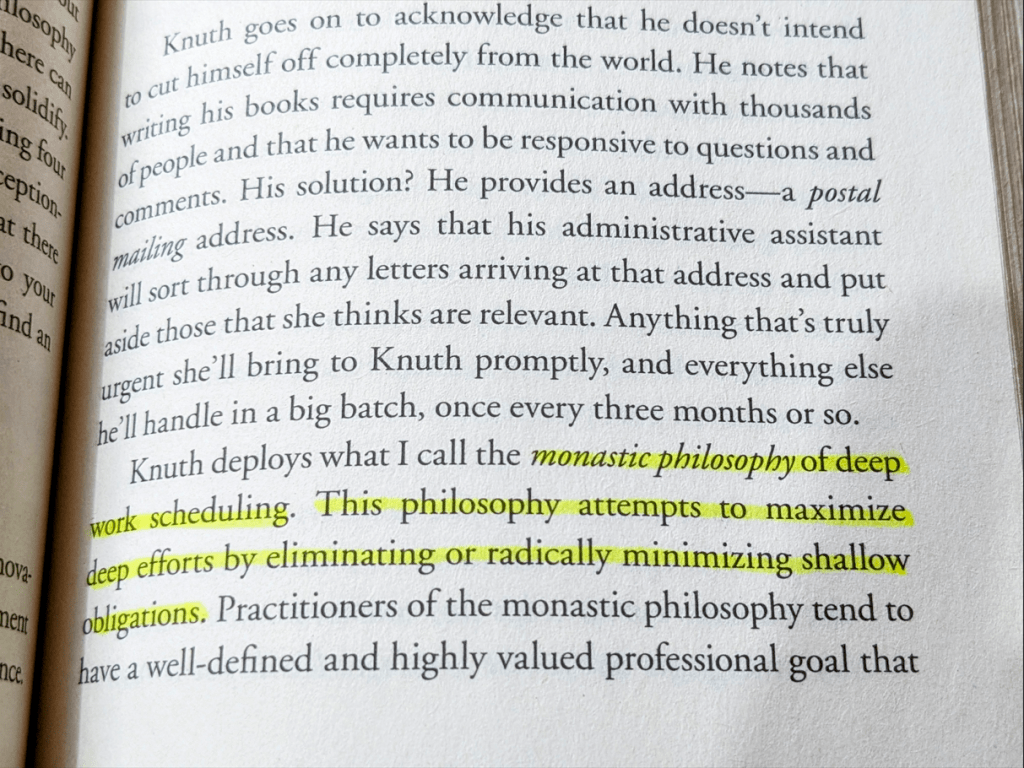
The monastic philosophy of deep work scheduling attempts to maximize deep efforts by eliminating shallow obligations.
To start the explanation, the author talks about a computer scientist named Donald Knuth, who is well known for his remarkable innovations in the world of computer science.
An interesting part of Knuth’s work ethic is his distaste for email. He claims that email is for people who always like to be on top of things, something that he could never be. His profession demands long hours of studying and uninterruptible concentration, which would be a lot harder to achieve if he had to respond to emails regularly.
The only way he allows people to contact him is through postal mail. Urgent letters would be brought to his attention promptly, while the rest would be handled in batches every few months.
By keeping himself far from shallow obligations, he is able to achieve great levels of depth professionally.
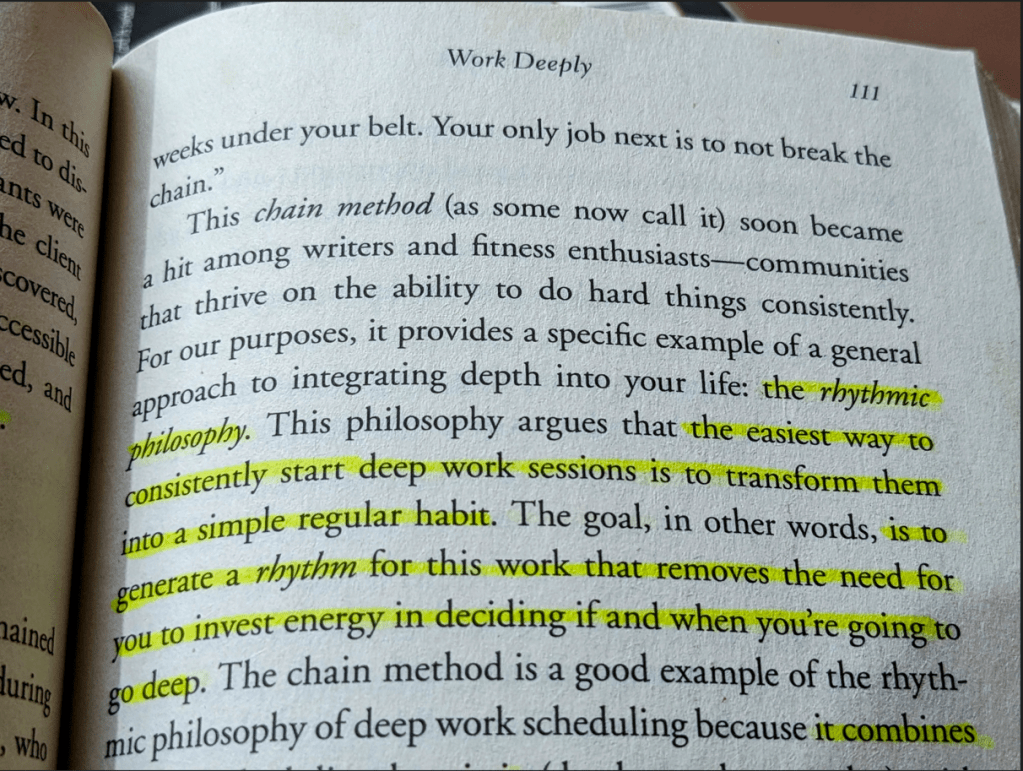
The Rhythmic Philosophy of Deep Work Scheduling
This philosophy argues that the easiest way to integrate deep work into our lives is to make it a regular habit. When we make it habitual, our schedules become more rhythmic and easier to follow.
The author talks about one of Jerry Seinfeld’s habits that he followed consistently. He keeps a calendar on his wall to track the days on which he writes jokes. Every day he writes jokes, and he crosses out the date on his calendar.
After a few days, this creates a chain. From that point on, the goal was not to break the chain and keep going.
The rhythmic philosophy teaches us the same. It’s about combining the end goal(working daily) with a way to remind yourself (cross mark on the calendar).
The author believes that this philosophy will help us log in a larger number of deep work hours by making sure that the work gets done regularly.
This book proved to be highly beneficial for my professional life, and I trust that it can also benefit yours. Thank you for reading. Have a great day!
 Wordsbykenaniah